


The Warren Buffett Principle
During our conversation, Fletcher shared a quote from Warren Buffett that has shaped his entire approach:
“Hire for integrity, motivation and intelligence. If the person lacks the first thing, then the other two will kill you.”
He’s built his entire hiring philosophy around this principle, even putting it in his email signature.
After working with small firms for over a decade, Fletcher has watched the talent crisis unfold firsthand. “The public accounting sector itself is just a brain drain,” he explained. When you attend industry conferences, you see the same generation of CPAs who “listen to the same music, watch the same movies, and your kids are all the same age now.”
That reality forces firms to rethink everything about hiring. I’ve learned you can’t cherry-pick perfect candidates anymore. Instead, you develop talent—admins who become tax managers, bookkeepers who grow into senior accountants, and career-changers who discover public accounting later in life.
What separates success stories from expensive failures? Integrity.
At Dillon Business Advisors, we define integrity simply as “doing the right thing because it’s the right thing to do.” I’ve learned that mistakes made with good intentions are fixable. Mistakes made with ulterior motives fracture relationships permanently.
Marcus adds another test we often reference internally:
“Would this pass the Wall Street Journal test? If it showed up on the front page tomorrow, would you be okay with that?”
The Five-Minute Test
Fletcher demonstrated his integrity test on Marcus and me during the episode.
“Have you ever told a white lie?” he asked.
“Have you ever hurt somebody’s feelings? Made a major mistake at work? Driven above the speed limit?”
When both of us answered yes, Fletcher explained the real insight: anyone who claims they’ve never done these things is being dishonest. He recalled a prospect who answered “no” to four out of five questions, then tried to justify his responses.
“Dude, you’re a liar,” Fletcher told him bluntly. “I don’t see us having a working relationship together.”
This test isn’t about catching people in trivial lies. It’s about recognizing that someone who misrepresents small truths will eventually compromise on bigger ones. When candidates answer honestly, Fletcher knows he’s dealing with someone who can admit mistakes and grow.
“You can coach people with integrity,” Fletcher explained. “They’ll be like, ‘Oh, I didn’t realize that. How do I get better?’ They’re not going to be defensive or argumentative.”
The Five-Day Sprint
Fletcher then outlined his hiring timeline:
“Monday, I do a phone screening. Tuesday, you complete the assessment. Wednesday, you come in for a career history interview. Thursday, I talk to your references. Friday, you have a working interview. Monday, I can have an offer to you.”
It sounds aggressive, but there’s a clear reason behind the speed. Unstructured interviews have only about 50% predictive accuracy—you might as well flip a coin. His structured approach dramatically improves outcomes:
-
Structured interviews with scorecards: +20–35% accuracy
-
Cognitive ability testing: +10–20% accuracy
-
Integrity assessments: +30% accuracy
Suddenly, you’re making decisions with 70–80% confidence instead of relying on gut feel.
Fletcher demonstrated his career performance history technique by putting Marcus on the spot.
“During your time at your last firm, what was your most significant accomplishment?”
Marcus, caught off guard, answered, “Survival.”
I couldn’t help but jump in:
“His biggest accomplishment was going from an auditor to taking over their tax practice as tax manager!”
That moment perfectly illustrated the technique’s power. What candidates emphasize—and what they gloss over—reveals exactly where they’ll thrive or struggle inside your firm.
Reference checks go even deeper. After warm-up questions, Fletcher asks the knockout question:
“On a scale of one to ten, compared to all other employees you’ve managed, how would you rate their performance?”
One firm tried this with an admin candidate they loved. The reference answered “six.” The truth poured out immediately.
Speed Matters More Than You Think
“People who are good have offers coming in,” I shared during the episode. In a typical two-week evaluation process, strong candidates often receive multiple competing offers.
Fletcher mentioned interviewing someone who had already turned down three offers from other firms. While some firms schedule a fourth meeting to “talk it through,” that candidate is accepting an offer from someone who moved decisively.
Speed doesn’t mean recklessness. Each step acts as a checkpoint. If the phone screen raises concerns and the assessment confirms them, the process stops—no wasted time for anyone.
Fletcher is firm on one non-negotiable rule:
“I will not do this for you unless you bring all the stakeholders into the conversation.”
The owner must be directly involved. Recruiting can’t be delegated to an admin with the expectation of great results.
The Three Ingredients Every Accounting Firm Needs
“Culture doesn’t mean you get to give somebody a 30% discount on what you pay them,” Fletcher said bluntly.
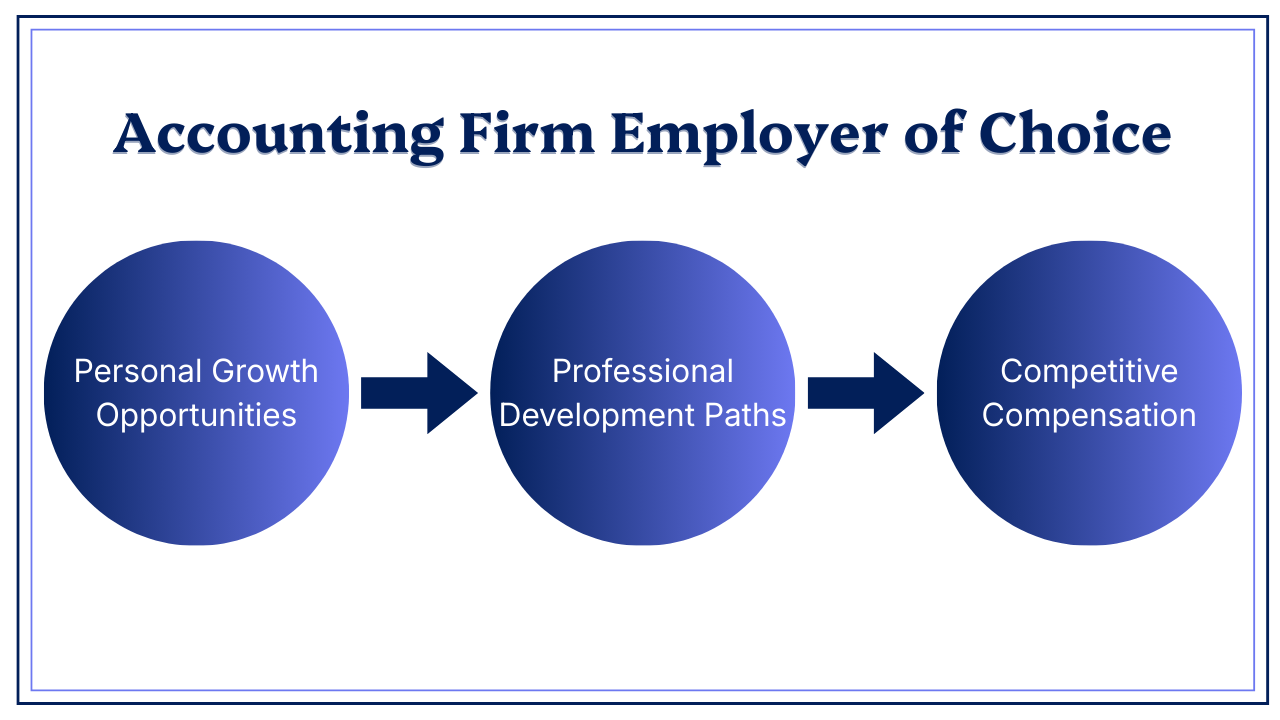
To become an employer of choice, firms need three ingredients: personal growth opportunities, professional development paths, and competitive compensation.
One of Fletcher’s clients takes a radically transparent approach, telling new hires:
“Here are your three paths. You can develop skills and eventually go out on your own—we’ll support that. You can become a technical expert who isn’t client-facing. Or you can become a revenue generator. We’ll help you reach whichever path you choose.”
The remote-versus-in-office debate often misses the point. In my experience, success depends on clarity—not location. Our team includes fully remote members who moved states during COVID, as well as recently acquired practices that operate in-office.
“We have flexible working hours,” I explained, “but not during our core hours Monday through Thursday, 10 a.m. to 2 p.m. There’s no flexibility there unless you’re taking PTO.”
That clarity matters. Fletcher warned that fuzzy promises about hybrid work create resentment when both sides realize they had different interpretations.
Your Next Move
The talent crisis isn’t going to solve itself. But accounting firms that prioritize integrity over pedigree, move decisively through structured evaluations, and position themselves as true employers of choice will build exceptional teams—while competitors remain stuck posting endlessly on job boards.
For Collective by DBA members and accounting professionals ready to transform their hiring, Fletcher offers free consultations and access to his assessment tools.
“I’ll give you unfettered, objective advice. Sometimes you might not like to hear it, but I’ll give it to you straight.”
His Discovered AI platform and GPT tool (now #1 on the GPT store) provide the structure most firms desperately need. You can find Fletcher on LinkedIn or reach him at fletcher@discovered.ai.
Listen to the full episode to learn why firms still posting on Indeed have already lost the talent war.


.png?width=11520&height=9216&name=Untitled%20design%20(22).png)